Many people use temporary email addresses to protect their personal inbox, avoid unwanted messages, and register for websites without sharing their main email account.
But a common question is simple: can websites detect temporary email addresses? In many cases, yes. Some websites use filters, domain lists, and automated checks to identify disposable inboxes before allowing registration.
This does not mean temporary email is useless. It only means you should understand how detection works, why some websites block it, and when it is still a helpful privacy tool.
Table of Contents
- Quick Answer
- How Websites Detect Temporary Email
- Why Some Websites Block Disposable Addresses
- Is Using Temporary Email Bad?
- When Temporary Email Usually Works
- When It May Not Work
- Privacy Benefits
- How Save & Restore Inbox Helps
- Best Practices
- Frequently Asked Questions
- Related Guides
Quick Answer
Yes, websites can sometimes detect temporary email addresses. They usually do this by checking the email domain against known disposable email lists or by using automated anti-abuse systems.
However, not every website blocks them. Many websites still allow users to register with a temporary inbox, especially for simple sign-ups, testing, downloads, and low-risk online services.
You can create a temp mail address instantly with TempMailo and use it for privacy-friendly online registration when appropriate.
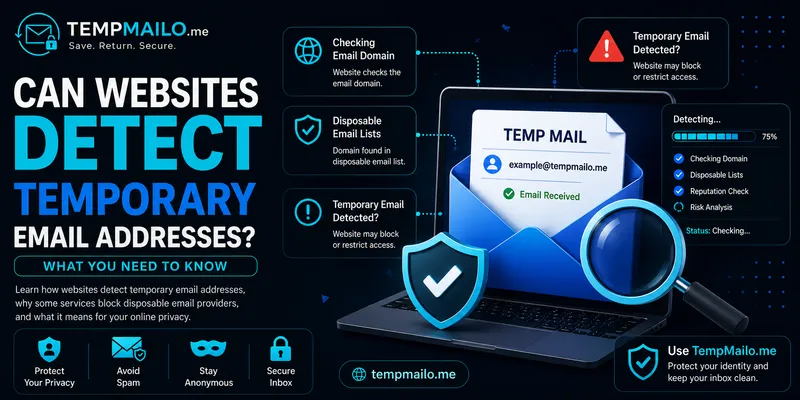
How Websites Detect Temporary Email
Websites do not usually detect the inbox itself. Instead, they often check the domain name after the @ symbol.
For example, if an email address uses a domain known to belong to a disposable email service, the website may block it or ask for another address.
Common detection methods include:
- Checking the domain against disposable email databases
- Using anti-spam or fraud prevention tools
- Blocking domains with high abuse reports
- Detecting patterns from repeated registrations
- Requiring extra verification such as phone confirmation
These systems are usually designed to reduce spam, fake accounts, and automated abuse.
Why Some Websites Block Disposable Addresses
Some platforms block disposable inboxes because they want users to provide a long-term contact method. This can help them manage account recovery, security notifications, billing messages, and customer communication.
Websites may also block temporary addresses to reduce fake accounts, automated sign-ups, and low-quality registrations.
From the user side, temporary email is often about privacy. From the website side, blocking it is often about security and account quality.
Is Using Temporary Email Bad?
No. Using a temporary inbox is not bad by itself. It is a legitimate privacy tool when used responsibly.
The important part is choosing the right situation. For quick registrations, newsletters, testing, and one-time access, temporary email can be useful. For banking, work, government services, or important accounts, a permanent email address is usually the better choice.
If you are unsure, read our guide: Is Temp Mail Safe?
When Temporary Email Usually Works
Temporary inboxes often work well for low-risk online activities where the website only needs to send a simple message.
- Receiving a download link
- Testing a new website
- Joining a forum temporarily
- Trying an online tool
- Receiving a basic confirmation email
- Separating personal inbox activity from public registrations
For these situations, a temporary email can save time and protect your personal address.
When It May Not Work
Temporary inboxes may not work on websites with strict verification rules. Some services want a permanent address because the account may involve payments, identity, security alerts, or long-term recovery.
It may fail on:
- Financial platforms
- Government websites
- Business tools
- Paid subscription services
- Platforms with strong anti-abuse systems
- Websites that manually block disposable email domains
If the account is important, use a regular inbox that you can access long term.
Privacy Benefits
Even if some websites detect disposable addresses, temporary email remains useful for privacy.
Every time you share your personal email address, there is a chance it may be used for marketing, tracking, or future promotional messages. A separate inbox creates distance between your main identity and websites you may only use once.
A disposable email address can help reduce unwanted messages and keep your primary inbox cleaner.
How Save & Restore Inbox Helps
One problem with traditional disposable inboxes is that access may disappear after a short time. This can be frustrating if a verification email arrives late or if you need the same inbox later.
TempMailo includes a Save & Restore Inbox feature. It allows you to save selected inboxes with a password and reopen them when needed.
This gives users more flexibility than many traditional temporary email services.
Learn more on the Save Temp Email page.
Best Practices
To use temporary email wisely, follow a few simple rules:
- Use it for low-risk registrations and testing.
- Do not use it for banking, work, or government accounts.
- Use a permanent inbox for accounts you need to recover later.
- Save the inbox if you expect future messages.
- Do not receive sensitive documents through a temporary inbox.
- Respect the rules of the website you are using.
Used this way, temporary email can support privacy without creating unnecessary account access problems.
Frequently Asked Questions
Can all websites detect temporary email?
No. Some websites use disposable email detection tools, while others accept temporary inboxes without any issue.
How do websites know an email is temporary?
They usually check the email domain against known disposable email provider lists or use anti-spam systems.
Can temporary email be used for verification?
Yes, many verification messages can be received through a temporary inbox, depending on the website’s rules.
Why do some platforms block disposable emails?
They may want to reduce fake accounts, prevent abuse, or make sure users have long-term access to account recovery messages.
Is disposable email illegal?
No. It is a legal privacy tool. The important point is to use it responsibly and follow website terms.
Should I use temporary email for important accounts?
No. Important accounts should use a permanent email address that you control long term.
Final Thoughts
Websites can sometimes detect temporary email addresses, especially when they check domains against disposable email lists. This is common on platforms that want to reduce fake accounts or require long-term contact information.
Still, temporary email remains useful for privacy, testing, and simple online registrations. The best approach is to use it for low-risk tasks and keep your permanent inbox for important accounts.